Revitalizing Scientific Heritage: The Strategic Value of Bryozoa by Ernst H. Haeckel in Modern Design
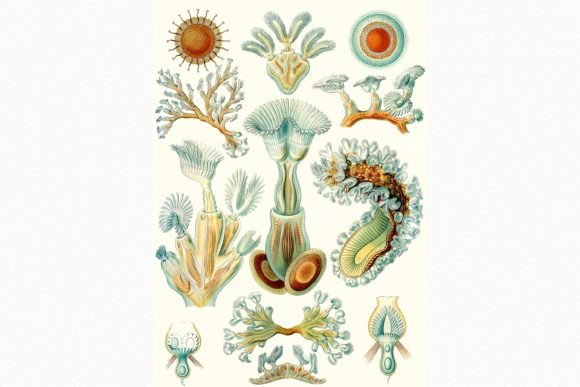
In an era where digital content is produced at an unprecedented rate, the quest for authenticity and depth has become a defining characteristic of successful creative work. Professionals across design, publishing, and marketing are increasingly turning away from generic, algorithm-generated imagery in favor of assets that carry historical weight and intricate detail. At the forefront of this resurgence is Bryozoa by Ernst H. Haeckel, a masterpiece of scientific illustration that continues to captivate audiences more than a century after its creation. This vintage artwork is not merely a relic of the past; it is a versatile, high-resolution asset that bridges the gap between 19th-century naturalism and contemporary visual communication.
The specific iteration available today—a Remix of an old and royalty-free drawing—offers creators a unique opportunity. With dimensions of 2325 x 3280 pixels and a resolution of 300 dpi, this file transcends the limitations of typical web previews. It provides the fidelity required for professional printing, large-format displays, and high-end product design. As we explore the utility and cultural significance of this image, it becomes clear why Bryozoa by Ernst H. Haeckel is becoming a staple in the workflows of forward-thinking entrepreneurs and artists.
The Intersection of Art and Science: Understanding Bryozoa
To appreciate the enduring appeal of this image, one must first understand its origins. Ernst Heinrich Haeckel was a German biologist, naturalist, and philosopher whose work in the late 19th and early 20th centuries revolutionized how humanity viewed the natural world. His collection, Kunstformen der Natur (Art Forms of Nature), remains one of the most influential works of biological illustration ever published. Within this vast catalog, the plate depicting Bryozoa stands out for its mesmerizing complexity.
Bryozoa, often referred to as moss animals, are tiny aquatic invertebrates that form colonies resembling delicate lace or coral. Haeckel’s rendering captures these microscopic structures with a precision that rivals modern photography, yet imbues them with an artistic elegance that science alone rarely achieves. He did not simply document nature; he interpreted it through the lens of aesthetic harmony. For the modern creator, this duality is invaluable. The image serves simultaneously as a scientifically accurate reference and a stunning piece of abstract art.
This blend of disciplines aligns perfectly with current trends in bio-mimicry and organic design. In industries ranging from fashion to architecture, there is a growing preference for patterns that reflect natural systems. By integrating Bryozoa by Ernst H. Haeckel into their projects, designers tap into a visual language that speaks of order, growth, and the intricate beauty of the natural world.
High-Fidelity Assets in a Digital-First Economy
One of the primary drivers behind the renewed interest in vintage scientific illustrations is the demand for high-quality, distinct textures in a saturated digital market. While stock photo libraries offer millions of images, they often lack the uniqueness required to build a strong brand identity. Here, the technical specifications of the Remix of an old and royalty-free drawing become critical.
The availability of this file at 300 dpi ensures that it meets the rigorous standards of professional print production. Whether used for stationery, invitations, or publishing, the image retains its crisp lines and subtle shading even when scaled up. This is a crucial distinction for professionals who cannot afford the blurriness or pixelation common in low-resolution downloads.
Consider the practical application in the following sectors:
- Arts and Crafts: Hobbyists and professional artisans use these high-res files for scrapbooking and card making, where texture and line quality are paramount.
- Fashion Design: Textile designers utilize the intricate patterns of Bryozoa to create prints for fabrics, leveraging the organic flow of the colonial structures for dresses, scarves, and accessories.
- Video Game Development: Concept artists incorporate these elements into game environments to create ancient, mystical, or bioluminescent backdrops that feel both alien and familiar.
- Blog Banners and Web Design: Marketers use the image as a sophisticated header or background element to elevate the perceived value of their content, moving away from flat, minimalist designs toward richer visual storytelling.
The assurance that the files you receive will be of much higher quality than what you see in this preview is a significant selling point. It removes the risk associated with purchasing digital assets online, ensuring that the final output matches the professional expectations of the client or audience.
Cultural Resonance and the "Vintage" Trend
Why are people paying attention to Bryozoa by Ernst H. Haeckel now? The answer lies in a broader cultural shift toward nostalgia and heritage. In a rapidly changing technological landscape, consumers and clients alike seek grounding in established traditions. The aesthetic of the Victorian era, characterized by detailed observation and ornate presentation, has seen a massive revival in interior design, branding, and lifestyle products.
This trend is not merely about looking backward; it is about recontextualizing the past for the future. The Remix aspect of this specific file acknowledges that while the original drawing is public domain, modern processing can enhance its usability without altering its soul. This approach resonates with the "upcycling" movement seen in sustainable business practices—taking something existing and giving it new life and utility.
Furthermore, the educational sector is experiencing a surge in demand for visually engaging materials. Teachers and content creators are using Haeckel's work to make complex biological concepts accessible and beautiful. The image of Bryozoa serves as a perfect entry point for discussions on marine biology, evolution, and the history of science, proving that educational tools can also be aesthetically pleasing.
Changing Workflows and Expectations
The way professionals source and utilize creative assets has evolved. The days of commissioning custom illustrations for every project are often replaced by the need for rapid deployment of high-quality, royalty-free resources. However, the expectation of quality has not diminished; if anything, it has risen. Freelancers and agencies are under pressure to deliver bespoke-looking results quickly.
Bryozoa by Ernst H. Haeckel fits seamlessly into this accelerated workflow. Because the image is royalty-free, it eliminates legal hurdles and licensing fees, allowing businesses to scale their creative output without administrative friction. Entrepreneurs launching new brands can use this image to instantly establish a tone of sophistication and intellectual depth.
Moreover, the versatility of the subject matter allows for cross-industry application. A single asset can serve as the inspiration for a fashion design line, a video game texture pack, and a set of business cards. This efficiency is highly valued in the modern economy, where resource optimization is key to profitability.
Practical Applications for the Modern Creator
To truly leverage the power of this image, creators should consider how it interacts with their specific medium. For instance, in scrapbooking, the black-and-white contrast of Haeckel's lines pairs beautifully with textured papers and watercolor washes, creating a layered, tactile experience. In digital publishing, the image can be used as a chapter divider or a cover element to signal a section dedicated to nature, science, or history.
For marketers, the image offers a narrative hook. Using Bryozoa by Ernst H. Haeckel in an advertisement campaign suggests that a brand values detail, history, and the natural world. It differentiates the brand from competitors relying on generic clip art or overused stock photos. The psychological impact of such imagery is profound; it subconsciously communicates competence and attention to detail.
Even in the realm of stationery and cards, the high resolution allows for embossing or foil stamping techniques that highlight the intricate details of the Bryozoa colony. The result is a luxury item that feels handcrafted, despite being produced using modern printing technologies.
Conclusion: A Legacy Reimagined
The journey of Bryozoa by Ernst H. Haeckel from a 19th-century scientific plate to a modern, high-resolution digital asset illustrates the timeless nature of great art. It demonstrates that the boundaries between science, history, and commerce are porous and that valuable insights can be found in unexpected places. For professionals, creators, and entrepreneurs, this image represents more than just a picture; it is a tool for differentiation, education, and aesthetic elevation.
As we move forward, the integration of such rich, historical assets into contemporary workflows will likely continue to grow. The demand for authenticity will only increase, driving the market toward resources that offer both quality and story. By embracing the Remix of an old and royalty-free drawing, creators ensure that their work stands out in a crowded marketplace, honoring the legacy of Haeckel while forging new paths in design and innovation. The files you receive are not just data; they are a bridge to a deeper understanding of our world, ready to be printed, shared, and celebrated in countless new forms.