Watercolor Natural Seashells Cliparts: A Practical Guide for Designers and Crafters
As summer approaches, the creative landscape shifts toward themes of coastal relaxation, beach vacations, and seaside memories. For designers, scrapbookers, and small business owners, capturing this specific aesthetic is often a priority. Watercolor Natural Seashells Cliparts have emerged as a staple resource for those looking to infuse their projects with an organic, hand-painted feel. However, with the digital marketplace saturated by vector graphics, 3D renders, and stock photography, understanding when and why to choose watercolor clipart requires a nuanced evaluation of your project's needs.
This guide explores the distinct characteristics of watercolor seashell assets, compares them against alternative formats, and helps you determine if this style aligns with your technical requirements and artistic vision.
Defining the Aesthetic: What Makes Watercolor Distinct?
The primary appeal of Watercolor Natural Seashells Cliparts lies in their ability to mimic traditional media within a digital workflow. Unlike vector illustrations, which rely on mathematical curves and solid fills, watercolor cliparts are raster images created by painting with actual pigments or high-fidelity digital brushes that simulate fluid dynamics. This results in soft edges, subtle color gradients, and the characteristic "bleed" where colors merge organically.
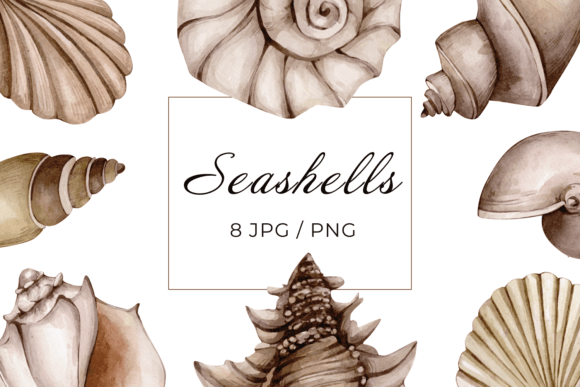
When evaluating a set like the one described—featuring eight elements at 300 DPI—the distinction becomes clear. These files capture the texture of paper and the translucency of paint, offering a warmth that crisp vectors often lack. For projects aiming to evoke nostalgia, such as memory scrapbooking or handmade-style greeting cards, this texture is not just a stylistic choice; it is essential for emotional resonance. The natural imperfections found in these shells make them feel collected from a real beach rather than generated by an algorithm.
Raster vs. Vector: Understanding Format Limitations
A critical factor in choosing Watercolor Natural Seashells Cliparts is understanding the difference between raster and vector formats. The clipart sets discussed here are provided in PNG and JPG formats, which are raster-based. This means the image is composed of a fixed grid of pixels. While this allows for the complex textures of watercolor, it introduces specific constraints regarding scalability.
- Resolution Dependency: Raster images are resolution-dependent. A file sized at 2500×2500 pixels looks sharp at its intended size but will lose quality if enlarged significantly beyond that point. Unlike vectors, which can be scaled infinitely without degradation, enlarging a raster image too much results in pixelation.
- DPI Considerations: The standard for high-quality print is 300 DPI (dots per inch). If the source file is 300 DPI, it is suitable for printing at its native dimensions. However, attempting to stretch a 2500px image to cover a large banner may require upscaling, which can damage the resolution quality.
- Background Flexibility: Most professional sets include both PNG (transparent background) and JPG (white background) versions. The PNG format is generally superior for layering over other design elements, while JPGs are useful for standalone prints or when a white border is desired.
If your project involves variable sizing—for example, a logo that must appear on both a business card and a billboard—a vector format might be a safer bet. However, for fixed-size applications like postcards, stickers, or web banners, the high-resolution raster files offer sufficient quality with greater textural depth.
Comparing Styles: When to Choose Watercolor Over Alternatives
Designers often face a choice between several visual styles for nautical themes. Each has its strengths, and the decision should hinge on the final output medium and the desired mood.
Watercolor vs. Flat Vector Art
Flat vector art is defined by clean lines and solid blocks of color. It is highly versatile, easily editable, and perfect for modern, minimalist branding. In contrast, Watercolor Natural Seashells Cliparts offer a softer, more romantic aesthetic. If you are designing a children's book about a beach adventure, the whimsical nature of watercolor may engage young readers better than stark geometric shapes. Conversely, for a corporate event flyer, the informality of watercolor might clash with a professional tone.
Watercolor vs. Photorealistic Stock Images
Photography offers absolute realism, but it can sometimes feel too literal or heavy in a layout. A photograph of a shell might dominate a page, whereas a watercolor illustration integrates more harmoniously with typography and other graphic elements. Additionally, watercolor allows for color manipulation that matches a brand palette more naturally than editing a photo, which can look artificial if forced into a specific color scheme.
Watercolor vs. Digital Painting
While digital painting can mimic watercolor, true watercolor cliparts often retain the unpredictability of wet-on-wet techniques. This "happy accident" quality is difficult to replicate perfectly with digital tools alone. For crafters seeking an authentic handmade look for wall art or journals, genuine watercolor scans provide a level of authenticity that purely digital creations may struggle to match.
Evaluating Suitability for Specific Projects
To make an informed decision, consider how Watercolor Natural Seashells Cliparts perform across common use cases. The versatility of a well-curated set extends beyond simple decoration.
Scrapbooking and Memory Keeping
This is perhaps the strongest fit for this asset type. Scrapbooking relies heavily on the tactile feel of materials. High-resolution (300 DPI) watercolor images printed on matte or textured paper blend seamlessly with physical photos and journaling. The soft edges prevent the "cut-out" look that can plague lower-quality clipart, making the layout feel cohesive and curated.
Card Making and Stationery
For greeting cards, invitations, and stationery, the romantic and gentle nature of watercolor is ideal. Whether creating wedding invitations with a beach theme or birthday cards for a child, these elements add a personal touch. The transparency of PNG files allows designers to place shells over patterned papers or watermarks without awkward white boxes obscuring the background.
Kids' Crafts and Educational Materials
In educational settings, the organic shapes of natural seashells are excellent for teaching biology or oceanography. The watercolor style is approachable and less intimidating than scientific diagrams. Teachers can use these high-res images to create worksheets, flashcards, or classroom decorations that stimulate curiosity without overwhelming students with complex details.
Web and Digital Design
While primarily designed for print due to their 300 DPI resolution, these files are also effective for web use. They can be downsized for blog headers, social media posts, or e-commerce product mockups. The key is to optimize the file size for web loading speeds while retaining enough detail to appreciate the brushwork. However, for responsive web design where images must scale dynamically, ensure you do not exceed the original pixel dimensions.
Decision Factors: Strengths and Tradeoffs
Before committing to a purchase or download, weigh the following factors to ensure the resource fits your workflow.
Strengths
- Aesthetic Depth: Provides a rich, hand-crafted look that is difficult to achieve with standard vector libraries.
- Print Readiness: At 300 DPI and 2500×2500 px, the files are ready for immediate high-quality printing on standard paper sizes.
- Layering Capability: Transparent PNG backgrounds allow for seamless integration into complex compositions.
- Emotional Connection: Evokes feelings of summer, relaxation, and nature, which is crucial for seasonal marketing.
Tradeoffs and Limitations
- Lack of Scalability: As raster images, they cannot be enlarged indefinitely. Users must plan their print sizes carefully to avoid pixelation.
- Fixed Color Palette: Unlike vectors, you cannot easily change the color of a watercolor shell using a fill tool. Recoloring requires advanced photo editing skills and may alter the texture.
- File Size: High-resolution raster files are larger in kilobytes than vector files, which may impact storage or upload times if not managed correctly.
Conclusion: Finding the Right Fit
Watercolor Natural Seashells Cliparts represent a specialized tool in the designer's arsenal. They are not a universal solution for every graphic need, but for specific applications requiring texture, emotion, and a connection to nature, they are unmatched. If your project prioritizes a handmade aesthetic, fixed print dimensions, and a warm, inviting atmosphere, these assets are likely the right choice.
However, if your workflow demands infinite scalability, frequent color changes, or a strictly modern geometric look, exploring vector alternatives may yield better long-term results. By understanding the technical distinctions between raster and vector, and the aesthetic implications of watercolor versus flat design, you can select resources that truly enhance your creative work rather than simply filling space. Ultimately, the best resource is the one that aligns with both the technical constraints of your project and the emotional story you wish to tell.